

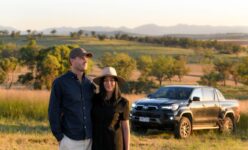
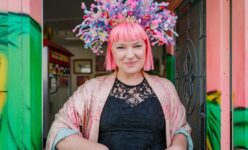





Tania Hartigan is a Contemporary Visual Artist, a mother to Alice and Robbie, wife to Rodney and a proud Gamilaraay woman with deep connections to Mother Earth. She describes her family’s move to their Wallabadah farm in 2004 as feeling fated. It’s there she uncovered ancient Aboriginal cultural sites, hosts retreats with renowned Australian artists and continues to build The Art Shack @ Wilgabah – a truly unique farmstay experience where art, Aboriginal culture and farm life combine.

I was a very quiet child. I remember getting home after school, heading straight outside to sit under the gum trees and sketch. I loved drawing, writing and reading. I’ve always been passionate about learning – to this day I’m forever curious to learn something new. So while I had friends, I enjoyed my own company too. I wasn’t afraid to get lost in my own thoughts and see what comes. They’re the moments I can start to create, when it’s just me, alone in my own space.
We moved around a lot, since dad worked on the railways. He was the youngest station master in the state at the time. Started at 15, retired at 58, hardly took a sick day and got the gold watch at the end. That’s how it was. Mum was an artist herself, and she still paints today. But when we were growing up her focus was on staying home to look after us – wherever home was at the time, from Woolbrook to Canowindra, back to Walcha. When we reached a certain age, she started working with people with hearing disabilities. She had some hearing loss herself, so she’d become very apt at lip reading over the years and was able to pass that on to others. It was amazing to watch.
But no matter where we were, my two younger brothers always had my back. We also grew up surrounded by cousins and grandparents. My mum was one of eight, so there were birthday parties most weekends, enormous Christmas celebrations and Easter gatherings. I think that’s something young kids miss today, that extended family with the aunts and uncles, grandparents and cousins. They’re some of the fondest memories I have.
My grandmother could spin a yarn, that’s for sure. She had a stroke when I was very little, so she was in a wheelchair for as long as I could remember. I’d sit by her side for hours, listening to her tell stories about the world, the land around us, about being on country. When her sister came to visit, the yarns got even longer. It might have been four in the morning and I’d be lying there, pretending to sleep but my little ears would be listening to every word she said. So yeah, my grandmother played a huge role in moulding the person I am today – alongside my parents of course.
As for creative influence, I guess my earliest memory outside of mum’s art comes from my primary school teacher in Woolbrook. There was a garage that was part of the principal’s residence, and this teacher turned it into a craft area. That wasn’t a common thing back then, to have a dedicated space for creating, so I’m very grateful for that. From those early, creative experiences, my art evolved in a self-taught way. Since we were moving around so much, there weren’t many opportunities to take on artistic subjects at school. By Year 11 we’d moved to Walcha so I did my senior years at Walcha Central. You probably had to do six subjects and you had six choices, that’s how it was – all with a grand total of 11 kids in the year. I had good friends though, they were all artistic too.
I think creative people have a way of finding each other, no matter where you are – it’s almost like there’s a gravitational pull. I wanted to pursue art after school, I loved photography and film too. But because I was this quiet, good little child, I did what my parents suggested. Dad said, “Get a good government job and you’ll be safe for life.” That’s how I ended up at the Teachers’ College in Armidale studying primary school teaching. Ironically, I ended up spending my entire teaching career in high school. Back then, there weren’t many jobs so you took what you could get. My first job was in Brewarrina, then Coonamble. I used to tell people I was making my way to the North Coast, I just never quite got there.

I decided to retrain after a while, and that’s when I went back and studied special education. After growing up with my grandmother in a wheelchair, I had this inner drive to help and support those around me. I also studied IT at Charles Sturt University and horticulture through the University of Melbourne. There’s that love of learning again, always keen to discover something new. By the time COVID hit, I’d given up teaching altogether and set my sights a little closer to home. I enrolled in a production horticulture course in bush foods and gave myself a project – I’d walk around the paddocks out here at Wilgabah to track down native plants I didn’t know. Then I’d sketch them and head home to try and identify them and learn what they were used for.
That’s me, still sketching beneath the gum trees. But when I went looking for art classes for my kids, there wasn’t anything available close to home. My daughter had been talking in tonal colours since she was a toddler, so it was something I really wanted to nurture. There was no way I’d be able to get them to Tamworth straight after school, especially when I was working full time. So I started hosting workshops out here, inviting artists to the Wallabadah Hall. In the first year we ran 20 workshops in the winter school holidays, covering drama and art. Kids could also choose their preferred medium too, whether that was watercolours or acrylics. One year, someone said, “This is all about the kids – could you have an art class for adults too?”
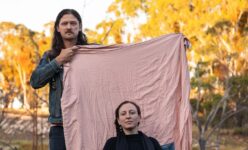
That’s how the artist retreats started – I kept contacting different artists to come visit, run workshops and stay a while. When it became a bit of a pain carrying all the equipment down to the hall, my husband Rodney built a studio here. Then we realised there wasn’t enough accommodation. People were travelling far and wide for our workshops, so we started building rooms for them to stay and rest a while, give them the chance to really switch off, sink into their art practice and maybe learn something new about the land around them while they’re here. We’ve built everything from scratch, using recycled materials wherever possible. None of it would exist without Rodney – it’s probably 10 per cent inspiration and 90 per cent perspiration on his part. Even the cottage walls from his childhood home are the walls in our dining room today. When his family farm sold, he went up there and did an IKEA and flat-packed it. It’s amazing to think the walls that wrapped around him back then still surround us today. Saying all that, he still cringes every time I say I’ve got an idea – that includes the time I decided to create six, two-metre tall handmade paper works for an exhibition at the Casula Powerhouse Arts Centre in Sydney. But that’s a story for another day.
Sometimes it feels like we were fated to come here. When we first moved to Wilgabah in 2004, we had no idea there were Aboriginal cultural sites on the land. They were completely covered in blackberries. But Rodney’s pretty anal about his weeds, so he got rid of everything and we discovered this amazing sandstone outcrop with over 200 grinding grooves on it. We were meant to find it, that’s how it felt. I have no doubt the previous owners over the past 150 years would have known it was there, but chose not to acknowledge it. Times have changed though, people are starting to understand that farmers can look after cultural sites and it doesn’t mean someone’s going to take their land off them.
We’re moving into a different era, into a time where we can all become quite proud of the Aboriginal sites and artefacts and see that it’s a part of Australian history. It’s a shift I’ve felt coming for the past 15 years. You can feel it. People are wanting to talk more openly about it. Still, there’s one word that remains. ‘Shame’ – it’s used a lot in Aboriginal communities, especially among Aboriginal kids. That word came about from people having to hide that they were Aboriginal.
The shame.
Don’t tell anyone you’re Aboriginal, if you’re fair enough and you can get away with it, don’t say a word. But I can feel that’s changing. And I realise some people don’t feel like it’s changing fast enough, but at least there’s movement in the right direction. Back in the 1800s people were shot because of the colour of their skin – nowadays people are wanting to have that conversation and realise that none of us have the truths of the people who lived back then. You might as well compare it to mediaeval times, when if you didn’t like someone you’d run them through with your sword. We don’t do that now either. I can feel change. Conversations are happening.
People still ask me if I’m Aboriginal. I say yes, I am. My mum’s side was Gamilaraay, the second-largest nation in New South Wales, and my dad’s side was First Fleet – came out on the Friendship as a marine and was one of the few who stayed. Now that’s an interesting combination. But the question around skin tone has carried on to the next generation too.
People would tell my daughter at high school that she wasn’t Aboriginal, usually by other darker-skinned Aboriginals. Certainly during my lifetime, if you’re a fairer-skinned Aboriginal, you sometimes feel like you’re not black enough, but you’re not white enough either. And here’s the thing – as the years go on, you have more and more Aboriginal people with fairer skin anyway. Everything changes. What we are today has obviously been impacted by our history, it’s made us who we are right now. But I don’t think it defines what our future is going to be. It’s important for all of us to remember that what happens next comes down to us and our children. We’re the ones who will determine what the next 100 years of Australia looks like, and if you ask me it’s looking pretty positive.
It’s on us to keep the conversation evolving, to stay curious, be open to learning, and reconnect with each other and the environment. Modern life happenings have stopped that – the global pandemic, technology. Now we feel like we have to take a step back, talk to people from a distance or through a computer. We don’t hug anymore – some people still cringe at the thought. But I think we should. We need to make sure we’re connecting with people and we also need to connect back to Mother Earth. Because if we’re not hearing what she’s saying, we’re not going to improve ourselves.
All these things and more are what I hope people can experience when they come visit us at The Art Shack. Slow down, relax, reconnect with the people around and disconnect from technology. We can literally turn the internet off if that’s something families would like. Show your kids that there’s more to the world than technology and pandemics. Make something with your hands, a didgeridoo, spear or boomerang. Paint, sketch, get your hands dirty and your knees muddy. Enjoy a homemade meal around the campfire, take a tour out on country, learn about Aboriginal culture and meet our friendly farm animals. It’s all here waiting for you, an open invitation to embrace the rhythm of rural life.
Photography Robbie Hartigan and Sally Auld
Visit The Art Shack @ Wilgabah
The Art Shack @ Wilgabah is where relaxation meets inspiration. Immerse yourself in the heart of Australian culture with this unique farm-stay experience that includes cultural heritage-listed site tours, bush tucker classes and artist retreats – a unique fusion of cultural exploration, artistic expression and the warm embrace of the countryside. The cosy on-site accommodation includes ensuites, kitchen, bbq and pool access, air conditioning, and a TV and Wi-Fi (unless you’d like that switched off!). To book your countryside escape today, contact The Art Shack @ Wilgabah.
107 Baldocks Road | Wallabadah NSW 2343 | 0427 462 155 | Website | Email | Facebook | Instagram
Tania Hartigan – the artist
Tania is a Contemporary, Gamilaraay Visual Artist. Her diverse talents span painting, printmaking and weaving, all of which have been showcased in numerous prestigious exhibitions and workshops. She especially loves portraits, a chance to get lost in someone’s face and capture them for that small moment in time. Tania is most at home in the personal paradise she’s created at The Art Shack @ Wilgabah, alongside her husband Rodney and their children Alice and Robbie. She loves to be immersed in the landscape and believes there’s nothing more relaxing than going for a walk in the bush – surrounded by the smell of gum leaves and native birdsong.
“We all look, but we don’t see. Art has taught me to slow down and take in the little details that slip past you when life is at full pace.”


Steph Wanless
Grammar-obsessed writer, Kate Bush impressionist, fuelled by black coffee, British comedy and the fine art of the messy bun. Also loves cats.


