

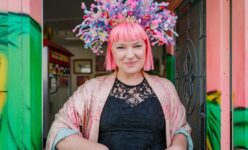





Ali Stoner is a woman with a plan, and that plan involves some seriously delicious food. Better known to her thousands of followers as ‘The Roving Haggis,’ the Glasgow-born, Melbourne-based cook and former MasterChef Australia contestant is on a mission to redefine what Scottish heritage looks and tastes like. This year, Ali is heading to the New England High Country as the Honoured Guest for the 2026 Year of Scotland at the Australian Celtic Festival. Before she packs her spices for Glen Innes, she sat down with REGGIE to chat about breaking cliches, the magic of the “natural larder”, and why we should all be eating more caramelised ox tongue.

Let’s start at the beginning – you grew up in Scotland but also lived in London for a long time. How did you find your way to Australia?
I moved to London when I was 18 to spread my wings and get into design. I thought I’d be there for a few years, but life happens! I met my husband, started a business, and had kids. Twenty-four years later, an opportunity popped up for my husband’s design business in Melbourne. We thought it’d be a short-term adventure, but 15 years later, we’re still here. I’ve lived in Australia nearly as long as I lived in Scotland and we love it here, but I still get back to Scotland three times a year to see my family.
When did the food career kick in?
I’ve always loved cooking at home, but moving to Melbourne and seeing the food culture here, and the whole MasterChef phenomenon, really sparked something. Getting onto the show was the turning point. Being immersed in that mix of different cultural heritages was a bit of a lightning bolt moment – it was my own Scottish heritage that made me stand out. The problem was, people didn’t immediately associate Scotland with ‘good food’, and I really wanted to change that.
Speaking of perceptions, what are the biggest cliches you’re trying to break when it comes to Scottish cooking?
Oh, it’s a tricky one! If you ask someone who isn’t from Scotland about the food, they usually go straight for the deep-fried Mars bar. It’s such a cliche. People assume traditional food is just boiled haddock heads or haggis, but they don’t realise how much of traditional Scottish food was actually introduced. Potatoes and ‘neeps’ (turnips) didn’t even arrive until the 17th century. My approach is about keeping tradition at the heart, but making it relevant. I’m not a historic cook. I want my daughters to pick up my book and find their heritage appealing and delicious, not just a museum piece.
We heard there’s a particular sandwich in your book that causes a bit of a stir. Tell us about the tongue!
Of course! It’s based on a childhood memory of pressed tongue that I actually hated as a kid. My reinvention is slow-cooked with spices, pressed, thinly sliced, and then caramelised in a pan. I layer it with aged Gruyere, pickles, and a ‘Scottish salsa verde’ (heaps of parsley and chives) in a toasted potato bun. It’s got these total posh burger vibes. If I didn’t tell you it was tongue, you’d just think it was the most sensational, melt-in-your-mouth meat you’ve ever had.
You’re the Honoured Guest at the Australian Celtic Festival in Glen Innes this year. What’s on the agenda?
I’ll be at the Ben Falls lunch on Thursday, doing a talk about these exact perceptions versus reality. We’re looking at how Scottish food is being beautifully transformed into something cross-cultural. I won’t be in the kitchen myself, but the team at Ben Falls is putting together a menu inspired by my work using local New England produce; I can’t wait. Then on Friday I’m at the Official Opening Ceremony at the Town Square, walking the ACF Celtic Food Trail, visiting the Porridge Making competition. I’m also doing a Celtic Cauldron session on the Sunday with food and travel writer Roberta Muir, where we’ll be talking about spices, including two specific blends I’ve developed myself that take me straight back to Scotland. It’s all about that sensory connection.
Is there a connection between the Scottish landscape and the regional areas like Glen Innes?
Absolutely. There’s a beautiful similarity in the ‘natural larder’. In Scotland, we were sustained for years by what could be grown inland, beef and lamb, and what came from the sea. Glen Innes has that same focus on incredible local produce. Despite being on opposite sides of the world, that connection to the land and how we access food is very much the same.
Why are festivals like the Celtic Festival so important for regional communities?
As I’ve gotten older, I’ve realised how vital that connection to heritage is. There are something like 40 million people worldwide with Scottish heritage, but only five million living in Scotland! The diaspora is massive. I think I had to leave Scotland to truly feel connected to it. These festivals give us a moment to celebrate that identity and share the stories, and the food, that make us who we are.
Catch Ali Stoner at the Australian Celtic Festival, Glen Innes, 30 April – 3 May 2026
- Thursday 30 April – 11am, Celtic Luncheon at Ben’s Falls Retreat, Emmaville NSW
- Sunday 3 May: The Celtic Cauldron spice session.
- Click here for more info and tickets!


